
Carpentry covers more ground than most homeowners give it credit for. It’s not just framing and finish work — it’s the door that’s been sticking since last winter, the cabinet hinge that lets the door hang crooked, the baseboard that pulled away from the wall, the closet with no real organization system. These are quality-of-life issues that get tolerated for years because they don’t seem urgent enough to call someone about.
They’re exactly the kind of jobs a skilled handyman handles every day.
At HomePro Handyman, our technicians bring 10+ years of hands-on carpentry experience to every project. That matters with this kind of work. Carpentry is visible — crooked shelves, gaps in trim, and misaligned doors are immediately noticeable — and getting it right requires more than just showing up with a saw and a level. Below is a thorough look at the carpentry work that falls squarely in handyman territory.
The Scope of Handyman Carpentry
The line between handyman carpentry and general contracting comes down to structural work. Load-bearing walls, major structural modifications, permitted additions — those belong with a licensed general contractor. Everything else: the repairs, installations, trim work, storage solutions, and finish carpentry that make a home more functional and polished on a daily basis — that’s handyman work. And there’s quite a lot of it.
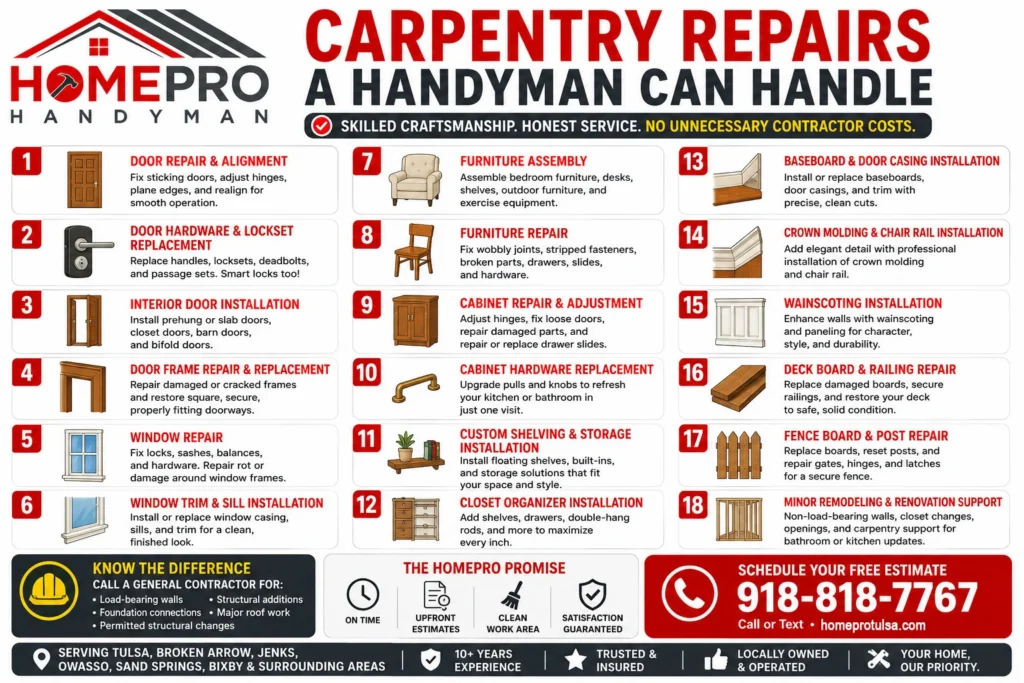
1. Door Repair & Alignment
Door repair and alignment is one of the most common carpentry calls a handyman gets, and for good reason. Doors shift as homes settle, as humidity expands and contracts the wood, and as hinges loosen over years of use. A door that sticks, drags along the floor, won’t latch properly, or swings open on its own is almost always a misalignment issue — a hinge adjustment, a slight trim of the door edge, or a strike plate repositioned to meet the latch where it actually lands.
This covers interior and exterior doors alike. An exterior door that doesn’t seal properly is also an energy issue, and one worth addressing before a Tulsa summer or winter makes it obvious.
2. Door Hardware & Lockset Replacement
Replacing a door handle, lockset, deadbolt, or passage set is straightforward work that makes an immediate difference. Hardware wears out, finishes oxidize, and older hardware often doesn’t meet current security standards. Upgrading all the hardware in a home to a consistent finish — brushed nickel, matte black, oil-rubbed bronze — is a project that takes a fraction of the time most homeowners expect.
Smart locks fall into this category as well. If the door already has a standard deadbolt cutout, installing a smart lock is a direct swap that a technician can complete in well under an hour.
3. Interior Door Installation
Hanging a new interior door requires precision from the start — a door that’s not plumb from the beginning will never operate correctly. Interior door installation includes prehung doors that come with the frame already attached, slab doors that need to be fit to an existing frame, closet doors, barn doors on hardware tracks, and bifold doors.
4. Door Frame Repair & Replacement
Door frames take abuse — from the door itself, from furniture moves, from the occasional hard impact. A frame that’s cracked, splintered, or no longer square affects how the door operates and, on exterior doors, can compromise weatherproofing and security. Frame repair often pairs with door alignment work for a complete fix rather than a temporary one.
5. Window Repair
Window repair covers the specific problems that develop with age: locks that no longer engage, sashes that stick and won’t open or close smoothly, balances that fail and leave the window falling on its own, and hardware that corrodes or breaks. Most of these are mechanical repairs that restore proper function without replacing the window unit itself.
Rot or damage around the window frame — particularly on older wood-framed windows exposed to Oklahoma weather — is also within carpentry scope, as long as it’s confined to the trim and frame rather than the structural rough opening.
6. Window Trim & Sill Installation
Window trim is what gives a window a finished, intentional look rather than a hole cut in a wall. Installing new window casing, replacing damaged sills, and restoring trim that’s been removed during a renovation are all standard carpentry tasks. Like all trim work, the quality shows in the details — tight miters, flush reveals, no gaps at the wall.
7. Furniture Assembly
The dirty secret of ready-to-assemble furniture is that the instructions are written for people who do this every day, not the person who bought one piece and is assembling it alone on a Saturday afternoon. Furniture assembly done by a technician who has built hundreds of these pieces means the finished product is stable, level, and correctly constructed — not slightly off in ways that compound over time.
This covers the full range: bedroom furniture, bed frames and headboards, dressers and wardrobes, office desks and chairs, bookshelves and entertainment centers, outdoor furniture, and exercise equipment.
8. Furniture Repair
Furniture that wobbles, has stripped fasteners, broken joints, or damaged hardware often doesn’t need to be replaced — it needs to be fixed by someone who understands how it’s actually constructed. Wobbling chairs and tables usually have a joint that’s worked loose; the fix is cleaning the joint and re-securing it properly rather than shimming or ignoring it. Drawer slides, hinges, and hardware can also be repaired or replaced without touching the piece otherwise.
9. Cabinet Repair & Adjustment
Kitchen and bathroom cabinets take daily use for decades, and the components that make them work don’t last forever. Cabinet repair and adjustment is often simpler than homeowners expect — European-style hinges are adjustable, which means a door hanging crooked or not closing flush can usually be corrected in minutes. Doors that are loose, damaged, or have stripped hinge screw holes are straightforward repairs that don’t require replacing the cabinet.
Drawer slides that have come off track, stick, or no longer close completely are another common repair. Updated soft-close slides can often be retrofitted onto existing drawer boxes.
10. Cabinet Hardware Replacement
Replacing cabinet pulls and knobs across a kitchen or bathroom has a bigger visual impact than its effort level suggests. New hardware can update a dated kitchen without paint or new doors. A technician can replace hardware across an entire kitchen in a single visit, fill and patch any holes from the previous hardware if the spacing doesn’t match, and ensure everything is installed consistently level.
11. Custom Shelving & Storage Installation
Custom shelving installation requires accurate measurement, proper wall anchoring, and an understanding of how weight distributes across a span. Floating shelves that aren’t anchored into studs or properly rated wall anchors will eventually fail under load — which is both a repair problem and a safety concern.
HomePro builds shelving solutions for living rooms, home offices, garages, and utility spaces — from wall-mounted systems to true built-ins that integrate with existing trim and architecture.
12. Closet Organizer Installation
A standard builder closet — one rod and a single shelf — wastes most of the available space. Adding a double-hang section, a shelf tower, shoe storage, and additional rods can double the functional capacity of the same footprint. A technician measures the space correctly, accounts for outlets and light fixtures, and makes sure the result is level and properly anchored.
13. Baseboard & Door Casing Installation
Baseboards and door casings are the transition points between walls and floors, walls and door frames. Trim and molding installation requires accurate miter cuts at corners and coped cuts where pieces meet at inside corners — the kind of joinery where the difference between a skilled and unskilled hand is immediately visible.
This covers new installations in freshly painted or renovated rooms, replacement of damaged sections, and matching existing profiles in older homes where the original trim has been discontinued.
14. Crown Molding & Chair Rail Installation
Crown molding runs the perimeter of a room where the walls meet the ceiling and adds a level of architectural detail that changes how a room feels. It’s one of the more demanding trim installations because the cuts are compound — accounting for both the angle of the wall and the angle of the ceiling — and any error is visible from across the room.
Chair rail creates a horizontal dividing line on a wall, typically at around 32 inches, and serves as both a decorative element and a practical surface protector in dining rooms and hallways.
15. Wainscoting Installation
Wainscoting — paneling on the lower portion of a wall — comes in several styles, from traditional raised-panel to simpler flat-panel and shiplap configurations. It adds texture, character, and durability to dining rooms, entryways, mudrooms, and bathrooms, and covers walls that have seen better days without requiring a full drywall repair and repaint.
16. Deck Board & Railing Repair
Deck repair is particularly common in Oklahoma, where hot dry summers and fast-arriving winter freezes take a sustained toll on outdoor wood. Individual boards or sections can be replaced without touching the rest of the deck structure. Loose or wobbly railings are a safety issue that should be addressed promptly — in most cases, the problem is a post base or connection point that’s worked loose and can be re-secured properly.
17. Fence Board & Post Repair
Fence repair tends to be isolated work — a few boards here, a leaning post section there. Replacing individual fence boards is straightforward. A leaning post requires digging out the base and resetting it correctly, but it’s still well within handyman scope. Gate hardware — hinges that have pulled loose, latches that no longer engage, self-closing mechanisms that have seized — is also a common repair that gets ignored until the gate stops closing entirely.
18. Minor Remodeling & Renovation Support
Not every remodeling project requires a general contractor. Building or removing a non-load-bearing wall, modifying a closet layout, framing a pass-through opening, or providing carpentry support for a bathroom or kitchen update are projects that fit within skilled handyman scope. These are the jobs that fall between “too small for a contractor” and “too involved for a typical handyman” — and they’re exactly what HomePro was built to handle.
When You Need a General Contractor
The boundary in carpentry is structural. Anything involving load-bearing walls, foundation connections, permitted structural additions, or major roof work belongs with a licensed general contractor. A HomePro technician will tell you clearly when a project crosses that line and help you understand what kind of professional you actually need.
What to Expect From HomePro Handyman
Every technician on the HomePro team brings more than a decade of hands-on carpentry experience. They arrive on time, in uniform, in a marked vehicle — and you’ll receive a name and photo before they knock. Before any work begins, you’ll get a written estimate with no hidden charges. When the job is done, your technician walks through the completed work with you and cleans up completely before leaving.
HomePro serves Tulsa, Broken Arrow, Jenks, Owasso, Sand Springs, Bixby, and the surrounding areas.
Call or text 918-818-7767 or schedule a free estimate online.