
Every homeowner has a mental list of repairs they’ve been putting off. For most people, anything involving electricity sits near the top — partly out of caution, partly because calling an electrician for a dead outlet or a wobbly ceiling fan feels like overkill. The bill rarely matches the problem.
Here’s what most people don’t realize: a significant portion of the electrical issues that come up in an average home don’t require a licensed electrician at all. Outlets, switches, light fixtures, ceiling fans, smoke detectors — these are all well within the scope of a skilled, experienced handyman. Knowing the difference saves you time, money, and the frustration of waiting a week for an appointment to fix something that takes an hour.
At HomePro Handyman, our technicians bring 10+ years of hands-on experience to every job. Below is an honest breakdown of what falls in handyman territory — and what genuinely requires a licensed professional.
The Line That Matters
Before getting into the list, it helps to understand where the line actually sits. The work that requires a licensed electrician in Oklahoma generally involves the electrical panel itself — adding new circuits, replacing breakers, upgrading service capacity — or pulling new wire through walls to create circuits that don’t exist yet. That’s specialized work with serious consequences if done incorrectly.
Everything else — the stuff connected to existing circuits, the devices and fixtures that plug into the infrastructure your home already has — is fair game for a qualified handyman. That covers more electrical repairs than most homeowners expect.
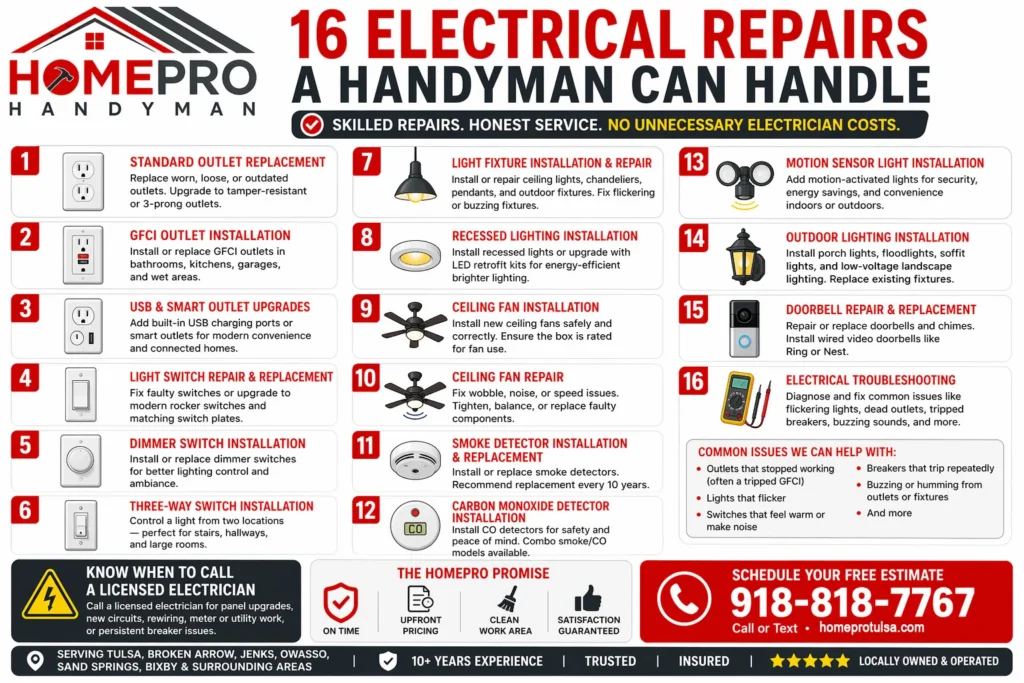
1. Standard Outlet Replacement
Outlets wear out. The internal contacts loosen over time, plugs stop holding firmly, and older ungrounded outlets become both a nuisance and a safety concern. Replacing a standard outlet is one of the most common electrical repairs a handyman handles — the existing wiring stays exactly where it is, and the new outlet drops right into place.
This also covers upgrading from two-prong to three-prong outlets where the wiring already supports it, replacing discolored or broken outlet covers, and swapping out builder-grade outlets for higher-quality tamper-resistant versions.
2. GFCI Outlet Installation
Ground Fault Circuit Interrupter outlets — the ones with the Test and Reset buttons — are required by code in bathrooms, kitchens, garages, and anywhere near water. Older homes often don’t have them, and even newer homes sometimes have GFCI outlets that fail and need to be replaced.
Installing or replacing a GFCI outlet is straightforward work for an experienced technician. It doesn’t touch the circuit itself, just the device at the end of it. If your bathroom outlet trips constantly, stops resetting, or was never a GFCI to begin with, this is an easy fix.
3. USB & Smart Outlet Upgrades
Modern homes run on devices, and the standard two-plug outlet wasn’t designed with that in mind. USB outlets — which include built-in charging ports alongside standard plugs — are a simple upgrade that makes a real difference in kitchens, home offices, nightstands, and living rooms.
Smart outlets that work with Alexa, Google Home, or Apple HomeKit fall into the same category. The wiring is identical to a standard outlet swap; the only difference is what you’re installing.
4. Light Switch Repair & Replacement
A switch that sparks, feels warm, makes a clicking sound when it shouldn’t, or simply stops working reliably is a switch that needs to be replaced. This is one of the most common calls a handyman gets, and one of the faster repairs on the list.
Beyond basic repairs, this includes replacing outdated toggle switches with modern rocker-style switches, swapping out mismatched switch plates, and replacing switches that have become loose or unresponsive over years of use.
5. Dimmer Switch Installation
Dimmer switches are one of the simplest ways to change the feel of a room, and the installation process is nearly identical to a standard switch replacement. The main consideration is compatibility — not all dimmers work with all bulb types, particularly LED bulbs — which is something an experienced technician will account for before recommending a product.
Existing dimmer switches that buzz, flicker, or fail to dim smoothly can also be repaired or replaced.
6. Three-Way Switch Installation
Three-way switches control a single light from two different locations — top and bottom of a staircase, both ends of a hallway. They’re slightly more complex than a standard switch because of the additional wire involved, but this is firmly in handyman territory. If you’ve ever wanted to add a second switch point for a light you currently have to walk across the room to control, this is the solution.
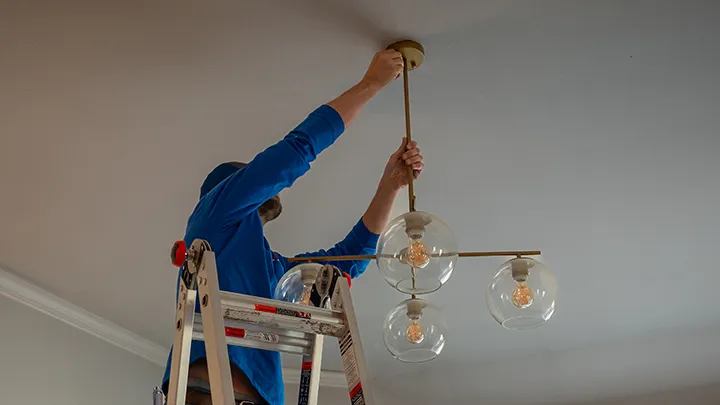
7. Light Fixture Installation & Repair
This covers a wide range of work. Swapping out a basic ceiling light for something more fitting, installing a chandelier in a dining room, adding pendant lights over a kitchen island, replacing an outdoor porch light — these are all standard handyman installations. The existing wiring and electrical box are already in place; it’s a matter of connecting the new fixture correctly and securing it properly.
Fixtures that flicker, buzz, or fail intermittently usually have a loose connection or a failing component. A technician can diagnose the issue and either repair the fixture or replace it, depending on what makes more sense.
8. Recessed Lighting Installation
Recessed lighting — also called can lights or pot lights — is one of the more common lighting upgrades homeowners ask for, and it’s achievable without a full renovation in most cases. Where an existing light fixture is already present, replacing it with a recessed light or a cluster of them is work a handyman can handle.
This includes LED retrofit kits, which drop into existing recessed cans and upgrade older fixtures to energy-efficient LED without replacing the housing itself.
9. Ceiling Fan Installation
Ceiling fans do two things well: they make a room feel cooler in summer and push warm air down in winter. Installing one correctly — so it runs quietly, doesn’t wobble, and operates safely — requires more than just following the included instructions.
The key variable is the electrical box in the ceiling. Standard light fixture boxes aren’t rated for the weight and movement of a ceiling fan. A technician will confirm the box is rated for fan use — or swap it out for one that is — before the installation begins. This detail is frequently skipped in DIY installs and is the most common cause of a wobbly or noisy fan.
HomePro also handles upgrades that add remote control or smart home capability to existing fans, which is often a simpler fix than homeowners expect.
10. Ceiling Fan Repair
A ceiling fan that wobbles, makes grinding or clicking noises, or runs inconsistently doesn’t always need to be replaced. Wobble is usually a blade balance issue. Noise often comes from loose screws, worn bearings, or a poorly secured mounting. Inconsistent speeds can trace back to the capacitor or the switch.
An experienced technician can diagnose what’s actually wrong before recommending a course of action. Repair is often faster and less expensive than replacement — and sometimes the better outcome.
11. Smoke Detector Installation & Replacement
Smoke detectors have a service life of 10 years. After that, the sensing chamber degrades and the device can no longer be relied upon — regardless of whether it still beeps when you press the test button. Most homeowners don’t know this, which means plenty of homes are running on detectors that are well past their useful life.
HomePro installs both battery-operated and hardwired smoke detectors, replaces aging units, and ensures placement meets current code requirements. For hardwired detectors, this means connecting to the existing wiring in the ceiling — which doesn’t require new circuits, just the knowledge to work with what’s already there.
12. Carbon Monoxide Detector Installation
Carbon monoxide is odorless and invisible, which makes a functioning detector non-negotiable in any home with gas appliances, an attached garage, or a fuel-burning furnace. Oklahoma requires CO detectors in new construction, but many older homes still don’t have them.
Installation follows the same logic as smoke detectors — battery or hardwired, proper placement, and confirmation that the device meets current standards. Combination smoke/CO detectors are also available and a good option for homeowners who want to consolidate.
13. Motion Sensor Light Installation
Motion-activated lights are one of the better security upgrades a homeowner can make without a major investment. They’re also useful for practical reasons — a garage light that turns on when you walk in, a hallway light that doesn’t require fumbling for a switch at night.
Most motion sensor installations replace an existing light fixture or switch, which means the wiring is already in place. The technician installs the new fixture or switch, adjusts the sensitivity and timer settings, and confirms proper operation.
14. Outdoor Lighting Installation
Outdoor lighting extends the functionality of a home’s exterior, improves curb appeal, and adds a meaningful layer of security. This includes porch lights, wall sconces, floodlights, soffit lighting, and low-voltage landscape lighting along walkways and garden beds.
Where an existing fixture is present, replacement is straightforward. Adding a new fixture to an exterior wall where wiring already runs nearby is also within handyman scope. New circuits run from the panel to a location that has no existing wiring — that’s licensed electrician work.
15. Doorbell Repair & Replacement
A doorbell that doesn’t ring, rings inconsistently, or has simply stopped working is usually a failed button, a loose connection, or a worn-out chime unit. These are all repairable. In many cases, the entire doorbell system — button, wire, and chime — can be replaced in under an hour.
Video doorbells (Ring, Nest, and similar products) are also within handyman scope when they’re wired. These connect to the same low-voltage wiring as a traditional doorbell, with the addition of a Wi-Fi connection for the app. A technician can handle the physical installation and wiring; getting the app configured is typically a five-minute process the homeowner handles from their phone.
16. Electrical Troubleshooting
Not every electrical problem announces itself clearly. Flickering lights, outlets that stopped working for no obvious reason, a breaker that trips repeatedly, a buzzing sound coming from behind a switch plate — these all have causes that aren’t always visible from the surface.
Troubleshooting is a skill that comes from experience. A technician who has seen hundreds of these situations knows what to check first, what the common culprits are for each symptom, and when what looks like a simple fix is actually pointing to something that needs a licensed electrician’s attention. That last part matters. A good handyman knows their limits and will tell you when the problem exceeds them.
Common issues that fall within handyman troubleshooting scope include:
- Outlets that have stopped working (often a tripped GFCI elsewhere on the circuit)
- Lights that flicker when a large appliance runs
- Switches that feel warm or make noise
- Breakers that trip repeatedly without an obvious cause
- Buzzing or humming from outlets or fixtures
When You Actually Need a Licensed Electrician
There are situations that fall outside handyman scope, and a reputable handyman will tell you so upfront rather than take the job and create a bigger problem.
Call a licensed electrician for panel upgrades and service changes, adding new circuits to your home, rewiring that involves running new wire through walls, anything involving the meter or utility connection, and persistent breaker issues that suggest a panel problem rather than a circuit overload.
If a troubleshooting visit reveals something in this category, HomePro will tell you clearly and help you understand what needs to happen next. That’s part of what it means to be a trustworthy local service — not taking work that’s outside the right scope just because a homeowner doesn’t know the difference.
What to Expect From HomePro Handyman
Every technician on the HomePro team brings more than a decade of hands-on experience. They arrive on time, in uniform, in a marked vehicle. Before any work starts, you’ll receive a written estimate — no surprises, no inflated charges after the fact. When the job is done, they walk through the work with you and clean up completely before leaving.
HomePro serves Tulsa, Broken Arrow, Jenks, Owasso, Sand Springs, Bixby, and the surrounding metropolitan area.
If you’ve got electrical repairs that have been sitting on the to-do list, most of them don’t require a week-long wait for an electrician. Call or text 918-818-7767 or schedule an estimate online.