
Floors take a beating. They’re walked on, dragged across, soaked, scratched, and ignored until something goes visibly wrong. By the time most homeowners notice a problem — a tile that rocks underfoot, a plank that buckles near the dishwasher, a section of grout that’s turned from white to grey-brown and started crumbling — the damage has usually been developing for a while.
Most of it is fixable without replacing the entire floor. That’s the part people don’t always know. Flooring repair is one of the more cost-effective handyman services because skilled technicians can isolate the damaged section, address it properly, and leave the surrounding floor untouched. The alternative — full replacement — is almost always unnecessary for problems that are caught before they spread.
At HomePro Handyman, our technicians bring 10+ years of experience working across every major flooring type — vinyl plank, laminate, tile, hardwood, and everything in between.
What Flooring Repair Actually Covers
Flooring repair isn’t one thing — it’s a category that includes surface damage, structural issues beneath the floor, and the trim and transition work that ties everything together. A cracked tile and a squeaky floor are both flooring problems, but they have completely different causes and completely different fixes. The common thread is that neither one requires a flooring contractor, a full tear out, or a week-long project.
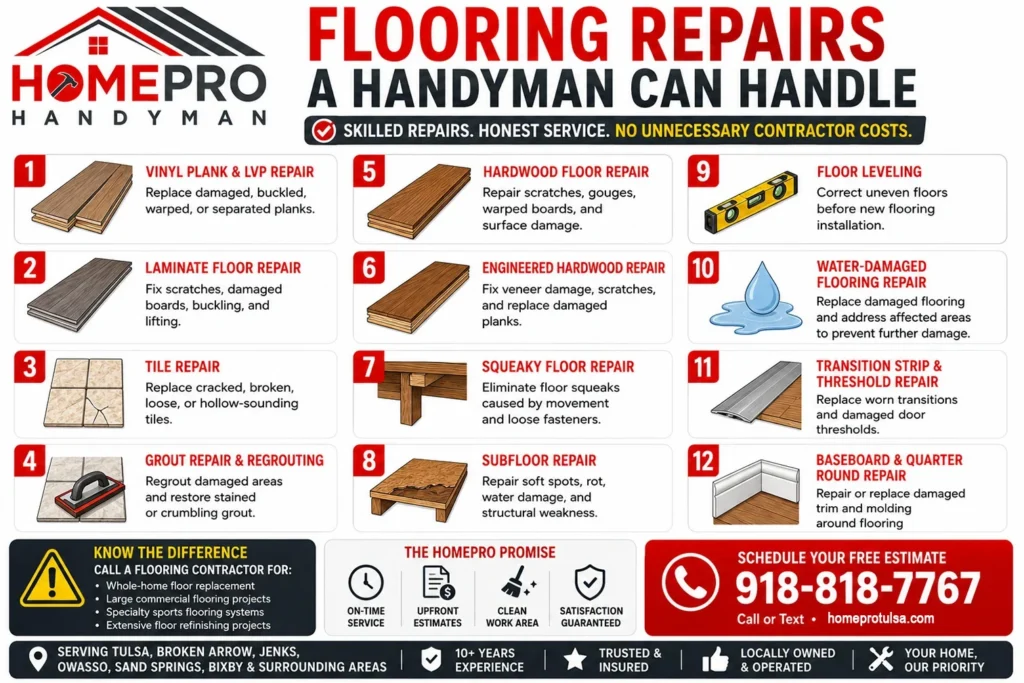
1. Vinyl Plank & LVP Repair
Luxury vinyl plank is one of the most durable flooring options available, but it isn’t indestructible. Heavy furniture legs can gouge the surface. Heat from direct sunlight causes planks to expand and buckle. Moisture that gets underneath — from a slow appliance leak, a pet, or a spill that sat too long — can cause planks to warp, lift at the seams, or separate at the click-lock joints.
Vinyl plank repair involves removing the damaged plank or planks, addressing the cause of the damage where possible, and installing replacement material that matches the existing floor. Because LVP installs as a floating system, individual planks can often be swapped out without disturbing the surrounding area — as long as replacement material is available. This is why it’s worth holding onto leftover planks from the original installation.
2. Laminate Floor Repair
Laminate has a reputation for being difficult to repair, and in some cases that’s accurate — a chip or gouge in the wear layer can’t be sanded down or refinished the way hardwood can. But scratches can be filled with color-matched repair compound, and damaged boards can be replaced individually when the floor uses a floating installation system.
The more common laminate problem is buckling or lifting, usually caused by insufficient expansion gaps at the perimeter of the room. Laminate expands and contracts with temperature and humidity changes, and when there’s no room to move, it pushes up from the center. A technician can relieve the pressure by adjusting the perimeter gap and resecuring the affected sections — often without replacing anything.
3. Tile Repair
Cracked or broken tile is one of the most common flooring repair calls. A single dropped cast-iron pan can crack a tile cleanly; settling or subfloor movement causes cracks that follow the grout lines or run diagonally across the surface. Either way, the fix is the same: remove the damaged tile without disturbing the surrounding tiles, and set a replacement.
The challenge is matching. Tile styles are discontinued regularly, and a perfect match isn’t always available. A technician experienced in tile repair knows how to source close matches, assess whether the remaining difference is noticeable, and in some cases suggest relocating an original tile from a less visible area to the repair location — then filling the less visible spot with the closest available alternative.
Loose or hollow-sounding tiles — the ones that shift or click underfoot — have lost their bond to the substrate below. They’re not cracked, but they’re a problem in progress. Resetting them before they crack is a faster and less expensive repair than dealing with broken tile later.
4. Grout Repair & Regrouting
Grout fails differently than tile. It stains, cracks, crumbles, and develops gaps at the edges where it meets walls, tubs, or cabinets. Discolored grout that won’t clean is often a surface issue that responds well to professional cleaning and sealing. Grout that’s crumbling, missing in sections, or allowing water to reach the substrate below needs to be removed and replaced.
Full regrouting — removing all the existing grout and replacing it — restores a tiled floor to like-new condition and is often the most practical solution when grout discoloration or damage is widespread. Grout sealing as a follow-up step protects the new grout and extends the time before the next maintenance is needed.
5. Hardwood Floor Repair
Solid hardwood is the most repairable flooring type. Surface scratches can be filled or blended. Deeper gouges can be addressed with color-matched filler. Individual boards that are cupped, warped, split, or damaged beyond surface repair can be removed and replaced — a more involved process, but one that preserves the rest of the floor.
Hardwood floor repair requires matching both species and finish, which takes experience and a good eye. The goal is always a repair that reads as part of the floor rather than a patch.
6. Engineered Hardwood Repair
Engineered hardwood has a real wood veneer over a plywood core, which means it looks like hardwood but behaves differently under repair. The veneer can’t be sanded as many times as solid hardwood, and deeper damage can reach the core. Surface scratches and minor damage can be filled; boards with significant damage can often be replaced if the floor was installed as a floating system. A technician can assess what the veneer will tolerate and recommend the right approach.
7. Squeaky Floor Repair
Squeaky floors are one of the most searched flooring problems homeowners deal with, and one of the most misunderstood. The squeak isn’t the floor failing — it’s movement between layers. Most often it’s the subfloor shifting against floor joists, or the finished floor moving against the subfloor. Neither situation is dangerous, but both get worse over time as the movement works fasteners loose.
The repair approach depends on what’s causing the movement and what’s accessible. Squeaks in hardwood floors can often be addressed from above with specialized fasteners. Squeaks in carpeted areas can be fixed from below if there’s a basement or crawl space, or from above using subfloor screws through the carpet. Identifying exactly where and why the movement is happening is the first step.
8. Subfloor Repair
Every finished floor sits on a subfloor, and the condition of that subfloor determines how well the finished floor performs. Soft spots, spongy sections, rot from past water damage, and delamination in older plywood subfloors all affect the stability and longevity of whatever goes on top.
Subfloor repair involves cutting out the damaged section, addressing any moisture source that caused the problem, and installing solid replacement material properly fastened to the joists. This is work that needs to happen before any new flooring is installed — skipping it and laying new flooring over a compromised subfloor just delays the problem and makes the eventual repair more expensive.
9. Floor Leveling
New flooring materials have tight tolerances. Luxury vinyl plank, in particular, requires a very flat substrate — most manufacturers specify no more than 3/16 of an inch of variation over a 10-foot span. When a subfloor doesn’t meet that standard, self-leveling compound is applied to fill low spots and create a flat surface for installation.
Floor leveling also applies to situations where a doorway transitions between rooms at different heights, or where a section of floor has settled or shifted over time. Getting the surface flat before laying new flooring is always the right investment — it prevents the clicking, flexing, and joint separation that result from installing over an uneven base.
10. Water-Damaged Flooring Repair
Water and flooring are a bad combination. Whether from a slow leak under a sink, an appliance failure, or a plumbing issue that went undetected, water damage in flooring tends to spread quietly before it becomes visible. By the time a floor feels spongy or a plank starts to buckle, the subfloor beneath it has often been affected as well.
Water-damaged flooring repair almost always involves removing the affected material to assess what’s underneath. If the damage is limited to the surface floor, replacement material can go back down after the subfloor dries. If the subfloor has been compromised, that gets addressed first. Acting quickly matters — the longer water sits in a floor system, the further the damage spreads and the more material has to come out.
11. Transition Strip & Threshold Repair
Transition strips are the metal, wood, or vinyl pieces that cover the gap between two different floor surfaces — hardwood to tile, carpet to LVP, flooring to a sliding door threshold. They serve a functional purpose and take constant foot traffic. Over time they come loose, get damaged, or simply wear out.
Replacing a transition strip is a fast repair that makes a noticeable difference in how a floor looks finished. Threshold repair at exterior doors is also worth attention — a threshold that’s warped, cracked, or no longer sealing properly creates both a trip hazard and a gap that lets outside air in.
12. Baseboard & Quarter Round Repair
When flooring is installed or replaced, the baseboard and quarter round trim at the perimeter of the room take damage. Quarter round — the small curved molding that covers the expansion gap between the floor and the wall — gets gouged, cracked, or separated from the base over time. Baseboard sections crack, pull away from the wall, or get damaged during moves.
Replacing damaged trim sections or reinstalling trim that’s pulled away restores the finished look of the floor without touching the flooring itself. It’s a detail that matters more than most people realize until it’s done correctly.
What to Expect From HomePro Handyman
Every technician on the HomePro team brings more than a decade of flooring experience. They arrive on time, in uniform, and ready to assess the situation honestly — which sometimes means telling you a repair is the right call and sometimes means telling you replacement makes more sense. Before any work begins, you’ll get a written estimate with no hidden charges. When the job is done, your technician walks through the completed work with you and cleans up completely before leaving.
HomePro serves Tulsa, Broken Arrow, Jenks, Owasso, Sand Springs, Bixby, and the surrounding area. Get your estimate today.